
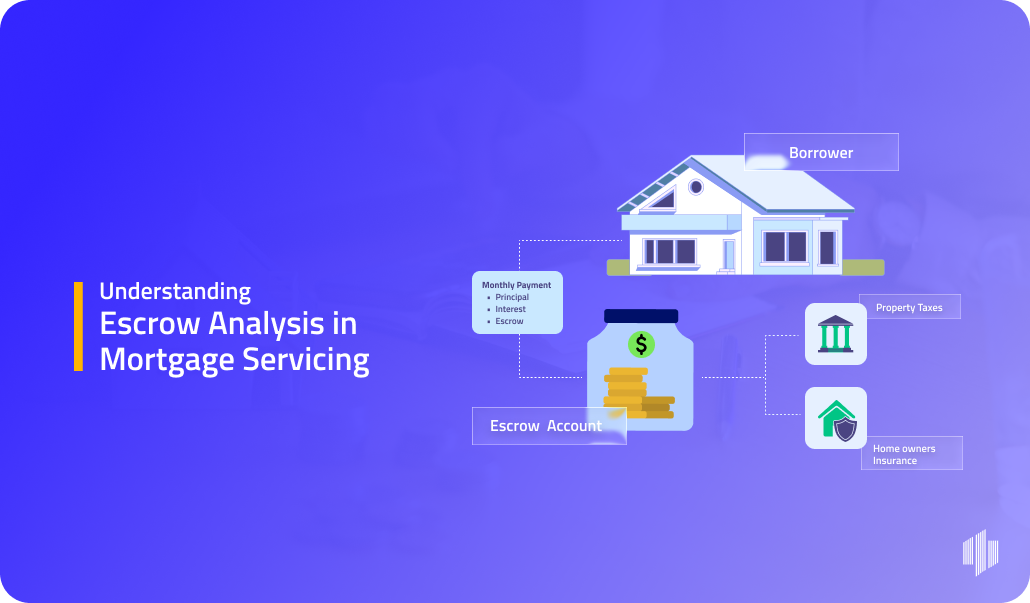
A practical guide to shortages, surpluses, cushions, and changes to a borrower’s monthly mortgage payment
A homeowner receives their annual escrow statement and notices an increase in their monthly mortgage payment. The interest rate hasn’t changed, and the loan hasn’t been refinanced. So, what’s causing the increase?
The answer often lies in the escrow.
Property taxes and insurance costs can change from year to year, affecting the amount a mortgage servicer needs to collect through the borrower’s monthly payment.
Understanding escrow analysis helps explain these changes. This article covers how escrow works, why servicers analyze escrow accounts, how shortages and surpluses are calculated, and how they affect the borrower’s monthly mortgage payment.
What Is Escrow?
After a mortgage loan closes, the mortgage servicer manages the loan and may collect monthly payments for an escrow account in addition to principal and interest.
The escrow account holds funds to pay property-related expenses, including:
- Property taxes
- Homeowners or hazard insurance
- Flood insurance, where required
- Mortgage insurance premiums (PMI or MIP), depending on the loan
Property taxes and homeowners insurance, commonly called T&I, are the primary focus of most escrow analyses.
Escrow works like a reserve funded gradually through monthly mortgage payments. The servicer uses these funds to pay tax and insurance bills when they are due.
Mortgage payments are often described using PITI:
Principal + Interest + Taxes + Insurance
Principal and interest repay the loan, while taxes and insurance generally make up the escrow portion. Escrow funds are also known as reserves or impounds.
Why Are Escrow Accounts Important?
A property serves as collateral for a mortgage loan, so keeping property taxes and insurance current helps protect both the homeowner and the lender.
Unpaid property taxes may result in a tax lien, putting the lender’s security interest at risk. Similarly, homeowners insurance helps cover repairs if the property is damaged by a fire, storm, or another covered event.
Escrow helps ensure that funds are available when these tax and insurance payments are due, reducing risks for both parties.
In simple terms, escrow helps protect the property, and the property protects the loan.
Why Can a Mortgage Payment Change?
A homeowner’s monthly mortgage payment can change when loan terms or property-related expenses change.
The principal and interest (P&I) portion may change when an adjustable-rate mortgage resets or the loan is modified. The escrow portion, however, changes when the costs covered by the escrow account increase or decrease.
Common examples include:
- Higher property taxes following a reassessment.
- Increased homeowners insurance premiums at renewal.
To ensure enough funds are available for upcoming tax and insurance bills, the mortgage servicer performs an escrow analysis to review projected expenses and determine whether the current monthly collection needs to be adjusted.
For loans subject to RESPA escrow requirements, this analysis is generally performed at least once during each 12-month escrow computation year.
How Does an Escrow Analysis Process Work?
An escrow analysis helps mortgage servicers determine whether an escrow account has sufficient funds to cover upcoming property tax and insurance expenses while maintaining the required cushion.

Figure 1: How an escrow analysis leads to a new payment
The servicer generally follows these steps:
- Reviews the current escrow balance.
- Estimates upcoming property tax and insurance expenses.
- Calculates the monthly amount needed to cover those expenses.
- Projects escrow deposits and payments month by month.
- Identifies the lowest projected account balance.
- Compares that balance with the permitted minimum balance, or cushion.
- Determines whether the account has a shortage, surplus, or neither.
- Calculates the adjusted monthly escrow payment, if needed
Escrow Analysis Example: Calculating a New Monthly Payment
Consider a homeowner currently paying $1,600 per month:
| Payment Component | Current Amount |
| Principal & Interest | $1,200 |
| Escrow | $400 |
| Total Payment | $1,600 |
Assume the mortgage has a fixed interest rate, so the $1,200 principal-and-interest portion remains unchanged.
During the annual escrow analysis, the servicer identifies increases in both property taxes and homeowners insurance:
| Escrow Expense | Last Year | This Year |
| Property Taxes | $3,000 | $3,600 |
| Homeowners Insurance | $1,800 | $2,040 |
| Total | $4,800 | $5,640 |
The base monthly escrow requirement therefore becomes:
$5,640 / 12 = $470 per month
Even before considering a shortage or surplus, the borrower’s escrow requirement has increased from $400 to $470 because the underlying tax and insurance expenses are higher.
What Is an Escrow Shortage?
An escrow shortage occurs when an escrow account is projected to have insufficient funds to cover upcoming property tax and insurance expenses while maintaining the applicable cushion.
For this example, assume the applicable cushion is $940 and the projected low account balance is $340. The shortage is the difference between these amounts:
$940 − $340 = $600
A shortage does not necessarily mean the borrower missed a payment. It can result from increases in property taxes or insurance premiums, or from differences between projected and actual escrow activity.
The shortage is then handled according to applicable escrow requirements. If the $600 shortage is repaid over 12 months, the calculation is:
$600 / 12 = $50 per month
This adds $50 to the borrower’s monthly mortgage payment during the repayment period.
What Is an Escrow Surplus?
An escrow surplus occurs when an account has more funds than needed to cover projected expenses while maintaining the permitted cushion.
A surplus may occur when:
- Property taxes decrease.
- Insurance premiums decrease.
- The borrower switches to a less expensive insurance policy.
- Actual disbursements are lower than projected.
Under RESPA escrow requirements, if the borrower is current on payments, a surplus of $50 or more generally must be refunded within 30 days of the escrow analysis. A surplus of less than $50 may generally be refunded or credited toward future escrow payments.
How Does the Escrow Analysis Change the Payment?
We can now bring the example together.
| Payment Component | Old Payment | New Payment |
| Principal & Interest | $1,200 | $1,200 |
| Escrow – Taxes & Insurance | $400 | $470 |
| Shortage Repayment | $0 | $50 |
| Total Monthly Payment | $1,600 | $1,720 |
The borrower’s payment increases by $120 per month.
That increase has two separate causes:
- $70 comes from the higher projected tax and insurance expenses.
- $50 comes from repayment of the $600 escrow shortage over 12 months.
Paying the shortage does not eliminate the increase caused by higher taxes and insurance. If the borrower pays the entire $600 shortage separately, the shortage repayment component may no longer be required, but the base escrow amount remains $470.
The resulting payment would therefore still be:
$1,200 P&I + $470 escrow = $1,670
This is one of the most important concepts in understanding an escrow statement: a shortage and an increase in future escrow expenses are related, but they are not the same thing.
Bringing the Escrow Analysis Together
The escrow process becomes easier to understand when viewed as one connected calculation.
In our example:
Annual T&I expenses: $5,640
↓
Monthly escrow requirement: $470
↓
Assumed cushion: $940
↓
Projected low point: $340
↓
Escrow shortage: $600
↓
12-month shortage repayment: $50/month
↓
New monthly mortgage payment: $1,720
Escrow analysis helps mortgage servicers align monthly collections with anticipated tax and insurance expenses. While changes in these expenses affect the ongoing escrow payment, an identified shortage may create an additional, temporary repayment obligation.
Understanding this distinction helps explain why a borrower’s monthly mortgage payment changes, even when the principal and interest remain unchanged.