

Transform servicing data into actionable intelligence by connecting information across systems, departments, and operational workflows.
Every servicing department generates valuable data. Customer service systems, default platforms, loss mitigation workflows, investor reporting, accounting systems, emails, spreadsheets, and PDF reports all contain insights that can improve operational performance.
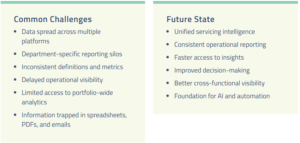
The challenge is that this information rarely exists in one place.
Without a unified view, servicing organizations spend significant time gathering data, validating reports, and reconciling conflicting information before meaningful analysis can begin.
Modern servicing organizations require more than dashboards. They need a framework that continuously collects, organizes, and enriches information from across the enterprise to create a trusted source for operational intelligence.
1. Data Collection & Consolidation Connect servicing platforms, accounting systems, warehouses, document repositories, emails, spreadsheets, and third-party sources.
2. Data Standardization & Validation Transform disparate formats into consistent and usable information across departments and functions.
3. Operational Intelligence Create unified views of servicing performance across customer service, default, loss mitigation, investor reporting, accounting, and treasury operations.
4. Analytics & Monitoring Track trends, KPIs, exceptions, and portfolio performance through centralized reporting and dashboards.
5. Predictive Insights Leverage historical servicing activity to identify trends, risks, and emerging operational opportunities.
6. AI Enablement Provide structured, connected data that can be leveraged by AI agents, automation workflows, and advanced analytics initiatives.
Most servicing organizations have access to enormous amounts of data. The challenge is not collecting information—it’s transforming fragmented information into something that can drive action.
Industry studies estimate that the majority of servicing data remains unanalyzed because it exists across disconnected systems and unstructured sources such as documents, emails, and reports.
Common Operational Challenges
– CIO, Mortgage Servicing
Process Transformation in Practice
A leading mortgage servicer implemented CrediVision.AI to create a centralized analytics framework across servicing operations. Prior to implementation, operational teams spent significant time gathering information from multiple systems, reconciling reports, and manually preparing analytics for management review.
By connecting servicing platforms, enterprise databases, documents, and departmental reporting sources, the organization established a unified data foundation that improved reporting consistency, accelerated access to operational insights, and prepared the business for future AI initiatives.
Before
|
After
|
Results
A more informed organization with better operational visibility, stronger analytics capabilities, and a scalable foundation for future automation.
CrediVision.AI was designed to help servicing organizations organize, connect, and operationalize data across the enterprise. The platform combines structured and unstructured information into a unified framework that supports reporting, workflow automation, analytics, and AI-driven initiatives. The underlying architecture includes enterprise data connectivity, knowledge management, AI orchestration, and agent-building capabilities.
CrediVision.AI enables:
– SVP, Servicing Technology
When servicing organizations establish a centralized analytics foundation, they improve visibility, increase operational efficiency, and create new opportunities for automation and innovation.
See how CrediVision.AI helps servicing organizations unify data, improve operational visibility, and establish the foundation for analytics, automation, and AI.