
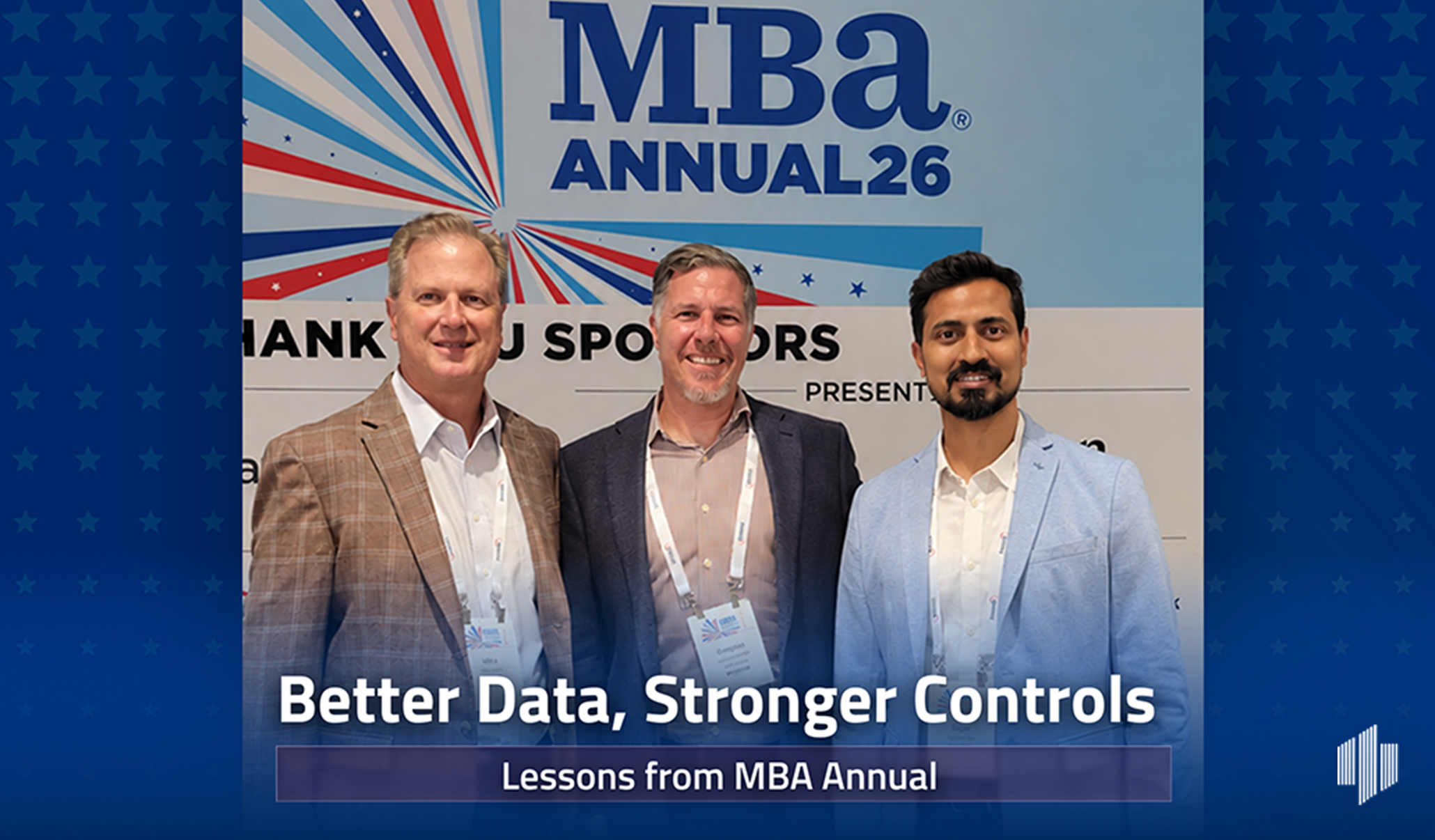
MBA Annual gave mortgage leaders plenty to consider about AI, technology investment, and the future of their businesses. For servicing organizations, the practical question is what those developments mean for the work their teams handle every day.
Looking back at the conference and the industry discussion around it, five priorities stand out: prepare the data, measure actual improvements, establish oversight, improve connections between systems, and keep learning from peers.
1. AI readiness starts with the data
Before adding AI to a servicing workflow, it is worth asking a few basic questions. Which system holds the authoritative record? Do teams use the same definitions? Who is responsible when information is incomplete or inconsistent?
MISMO President Brian Vieaux put the issue plainly in his September article: “Before we ask whether our mortgage company is AI-ready, are we certain that our data is ready?” He identified consistent definitions, data lineage, authoritative sources, and clear ownership as essential foundations.
For servicing teams, that means looking closely at the information moving between servicing, accounting, and reporting systems. If your team is repeatedly reconciling conflicting records or interpreting unfamiliar fields, those issues need attention before automation can reliably build on them.
2. Technology should make daily work measurably better
A long feature list does not tell an operations leader whether a system will help the team resolve an exception or validate an invoice.
The more useful questions are specific:
- How many manual steps can the team eliminate?
- How quickly can someone identify and resolve an exception?
- Can reviewers trace a number back to its source?
- Does the process remain manageable as portfolios and client relationships grow?
These are the measures we believe should guide technology decisions. Start with a workflow, establish how it performs today, and define the improvement that would justify the investment.
For investor accounting, that might mean less time investigating reconciliation differences. For subservicing billing, it might mean fewer manual checks. For investors, it could mean clearer oversight across multiple subservicers.
3. Governance needs to be part of implementation
As companies consider where to use AI, they also need to decide who is accountable for its work.
MISMO’s announcement of six inaugural FRAME Advisory Partners reflects a practical effort to help lenders and servicers implement its Framework for Responsible AI in the Mortgage Ecosystem. The program focuses on translating governance principles into operating practices.
For servicing leaders, that raises straightforward questions regarding what the technology can do independently and what requires human review. Answering those questions early gives teams a clearer basis for implementation and ongoing oversight.
4. Integration requires shared meaning, not just moving data
Connecting applications is only part of the work. Teams also need to agree on what the information means.
Vieaux’s September article notes that the MISMO Business Glossary contains more than 8,000 terms and definitions. That shared vocabulary addresses a familiar problem. Different systems and teams can use different names for the same information, or the same name for different things.
For servicing operations, the practical work includes confirming field definitions, mapping data consistently, identifying the source of record, and assigning responsibility for handoffs.
Those details matter when reconciling accounts or bringing portfolio information into a consolidated view.
5. Keep the conversations going
The value of a conference should extend beyond the event itself. Comparing experiences with peers, customers, and technology partners can help teams test their assumptions and identify where a process needs closer attention.
The useful next step is to choose one issue worth pursuing, not return with a longer list of possibilities.
That might be a reconciliation process that depends on too many spreadsheets, a recurring billing question, or a reporting handoff with unclear ownership. Bring the right people together and agree on what a better process should look like.
For Integra, our takeaway is that modernization should strengthen the controls, visibility, and continuity that servicing organizations depend on.
Start with a process that creates recurring friction. Confirm the data behind it, establish ownership, and define a measurable improvement. Then evaluate how technology can help.
If investor accounting, subservicing billing, or portfolio oversight is on your team’s agenda, we welcome a conversation about where to begin.