
Investor reporting is getting faster.
Fannie Mae is moving toward near-real-time, event-based servicing reporting, with loan-level servicing events expected to be reported the same day they are processed, subject to the applicable next-business-day cutoff. Freddie Mac is moving in the same direction: effective February 1, 2027, servicers must report loan-level transactions on the same day they are processed, no later than 3:45 a.m. ET the next business day.
For investor accounting teams, this raises an interesting question.
If servicers and the GSEs increasingly see the same activity at nearly the same time, should reconciliation become less important?
Probably not.
What changes is not the need for reconciliation, but how and when it happens.
Faster reporting does not guarantee the same financial outcome
Consider a transaction moving from a servicing system into an investor reporting process.
The transaction can be transmitted successfully. The API can respond successfully. The event can reach the GSE within minutes.
Technically, everything worked.
But that does not necessarily mean the resulting financial position is correct.
The transaction could still be mapped differently, processed under the wrong business rule, assigned to a different reporting period, reflected incorrectly in a remittance calculation, or affected by an adjustment that exists in one system but not another.
This is the distinction that matters:
Integration asks whether the data moved.
Reconciliation asks whether both sides arrived at the same financial truth.
Moving data faster does not eliminate that distinction.
Connected does not mean consistent
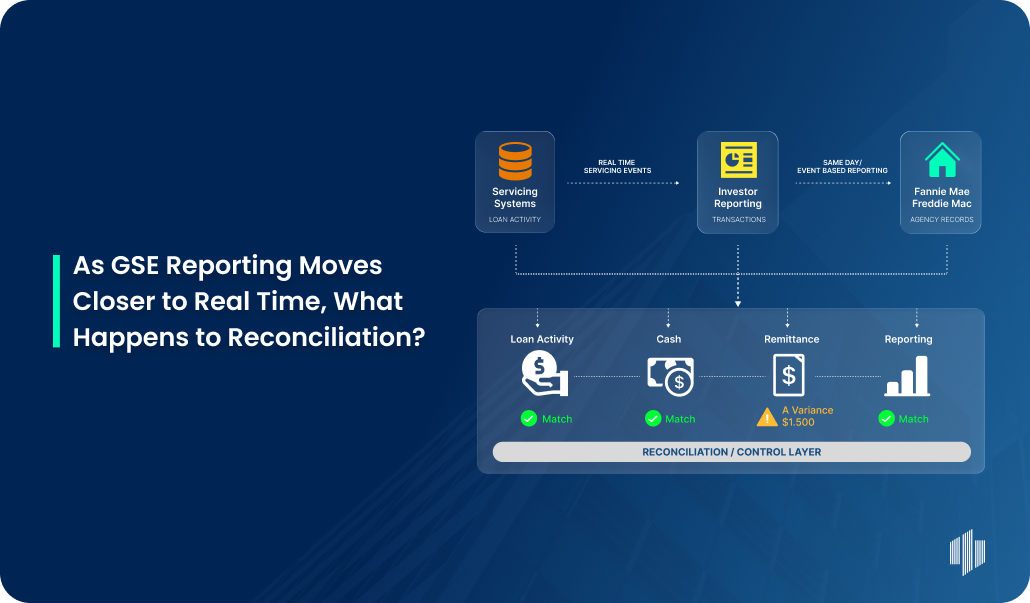
Investor accounting sits across several representations of the same financial activity: the servicing system, custodial bank activity, general ledger, investor accounting platform, remittance calculations, and agency or investor records.
These systems can all be connected and still disagree.
A borrower payment may be processed before the related cash settles. A cutoff difference may place activity into a different reporting period. A business rule may calculate a remittance differently. An adjustment may appear in one system before another.
None of this necessarily means an integration failed.
It means connectivity and financial consistency are different problems.
Reconciliation is the control between them.
And as the ecosystem becomes faster, that control needs to become faster too.
What should investor accounting teams be thinking about now?
The move toward more event-driven reporting is not simply an integration project. It is an opportunity to reconsider how investor accounting controls operate.
Three questions are particularly important.
Can we reconcile throughout the reporting cycle?
If source-system and agency data are becoming available sooner, there is less reason to wait until the end of a reporting cycle to identify a difference.
Fannie Mae’s Loan Servicing Data Utility already reflects this direction. Fannie describes LSDU as providing near-real-time loan-level data and exceptions that allow servicers to reconcile loan and cash positions throughout the month rather than only at the end of the monthly reporting cycle.
Can we explain an exception, not just identify it?
Knowing that two numbers do not agree is only the beginning.
The real operational value comes from determining why: timing, source data, mapping, transformation logic, investor-specific rules, cash movement, or a genuine financial exception.
As reporting cycles compress, exception investigation will need to compress with them.
Can our controls operate at the same speed as our reporting?
If transactions are reported in near real time but reconciliation remains heavily manual and retrospective, the bottleneck simply moves downstream.
That is where the operating model has to evolve.
Some reconciliation should disappear
There is an important nuance here. Modernization should eliminate certain reconciliations.
Fannie Mae, for example, says its servicing changes are intended to reduce timing-related discrepancies and redundant reconciliation. For summary reporting Actual/Actual loans, Fannie also plans to automatically initiate P&I drafts based on successfully processed payment events, eliminating the existing monthly shortage/surplus reconciliation using Schedule 3, Form 472.
That is exactly what good modernization should do.
When a reconciliation exists mainly because two disconnected processes operate on different schedules, redesigning those processes may remove the need for that reconciliation altogether.
But that is different from saying reconciliation as a control disappears.
The focus shifts from manually reconciling everything to validating the areas where systems, rules, cash, and financial outcomes can still diverge.
Reconciliation has to move at the speed of reporting
Historically, reconciliation has often followed a cycle: end of day, end of reporting period, or month-end.
That made sense when much of the underlying data also moved in batches.
Event-driven reporting changes that assumption.
If a payment is reported today, why wait until month-end to discover that its expected financial effect does not agree?
If a reversal changes a remittance position, why wait for a periodic process to surface it?
If an exception is caused by a mapping or business rule, why allow hundreds or thousands of additional transactions to follow the same path before investigating it?
The opportunity is to move reconciliation closer to the transaction.
That changes reconciliation from a periodic checking activity into a more continuous financial control.
The future is less manual reconciliation
This does not mean analysts should continuously compare transactions throughout the day.
Quite the opposite.
As reporting becomes more event-driven, routine matching should increasingly happen automatically. Exceptions should surface as they emerge, and systems should help identify probable root causes and assemble the evidence required to investigate them.
AI can accelerate this further by helping classify exceptions, identify patterns, summarize evidence, and recommend next steps.
But AI does not remove the need for independent verification. It changes where people spend their time.
The human role shifts from matching large populations of transactions to resolving the smaller number of situations where the financial outcome remains uncertain.
That is a much more scalable model.
From periodic reconciliation to continuous confidence
The GSE reporting changes represent more than faster data exchange.
They point toward an environment where servicing events, investor reporting, cash movement, and controls can operate much closer together.
For investor accounting teams, the opportunity is therefore bigger than making today’s reconciliation process faster.
It is to reconsider when reconciliation happens, which reconciliations should disappear, which controls should remain, and how quickly an exception can be understood and resolved.
As reporting moves closer to real time, reconciliation cannot remain only a month-end activity.
It needs to evolve with it.
Integration creates connectivity.
Reconciliation creates confidence.
And the next generation of investor accounting will need both.