AI Lite: The Importance of Humans in the Loop for Investor Accounting & Reporting

Artificial intelligence is making meaningful inroads into mortgage servicing—but nowhere is the balance between automation and control more critical than in investor accounting and reporting. 

Daily remittances, custodial reconciliations, trial balances, and investor reporting packages are the financial backbone of servicing operations. They demand precision, auditability, and strict adherence to investor guidelines. While AI can dramatically improve efficiency in these areas, a fully autonomous approach introduces unacceptable risk. 

The Opportunity: Where AI Adds Immediate Value 

Investor accounting is rich with structured data and repeatable processes—making it an ideal candidate for targeted AI deployment. 

High-impact use cases include: 

1. Data Ingestion and Normalization 

AI can streamline the intake of: 

  • Investor remittance files 
  • Bank statements and custodial account activity 
  • Loan-level servicing data 

Intelligent parsing and normalization reduce manual effort and improve data consistency across systems. 

2. Reconciliation Acceleration 

AI-driven matching algorithms can: 

  • Auto-reconcile cash movements across custodial accounts 
  • Identify breaks between servicing system balances and bank activity 
  • Flag exceptions in real time 

This significantly reduces the time required for daily and monthly reconciliations. 

3. Exception Identification and Prioritization 

Instead of teams manually hunting for discrepancies, AI can: 

  • Surface outliers in remittance calculations 
  • Detect anomalies in principal and interest distributions 
  • Prioritize outages based on materiality and risk 

4. Reporting Assembly 

AI can assist in: 

  • Compiling investor reporting packages 
  • Pre-validating data against investor rules 
  • Generating narratives for standard reporting outputs 

In these areas, AI enhances throughput and reduces operational drag. 

5. Adherence to Procedures 

AI can read your standard operating procedures (SOPs) and ensure these practices are consistently followed throughout your business processes. Plugging AI into your workflows can: 

  • Enforce policies and controls—even when they are not explicitly hardcoded into the application 
  • Check for the presence of required supporting documentation before submission to QA 
  • Validate analyst actions in real time and offer corrective suggestions 

The underlying system will: 

  • Continuously monitor workflows against defined SOPs and flag deviations as they occur 
  • Create a real-time audit trail of adherence, exceptions, and overrides 
  • Adapt to updates in procedures without requiring full system reconfiguration 
  • Reinforce consistency across teams, reducing reliance on tribal knowledge 

This transforms SOPs from static documentation into active, embedded controls within daily operations—ensuring that processes are not just defined, but consistently executed. 

The Risk: Why Full Automation Falls Short 

Despite the structured nature of investor accounting, it is far from simple. Variability across investors, edge cases, and strict compliance requirements introduce layers of complexity that AI alone cannot safely manage. 

Key challenges include: 

Investor-Specific Nuance 

Different investors (e.g., Fannie Mae, Freddie Mac, Ginnie Mae) have: 

  • Unique remittance structures 
  • Distinct reporting formats 
  • Evolving guideline interpretations 

AI may struggle to correctly apply nuanced rules without explicit, continuously updated context. 

Exception Complexity 

Not all breaks are created equal: 

  • Timing differences vs. true cash discrepancies 
  • Loan-level anomalies that require historical context 
  • Edge cases tied to servicing transfers or modifications 

These require judgment, not just pattern recognition. 

Regulatory and Audit Exposure 

Investor accounting outputs feed directly into: 

  • Financial reporting 
  • Compliance attestations 
  • External audits 

An incorrect AI-driven adjustment—even if rare—can have outsized consequences. 

AI Lite Strikes the Right Balance 

This is where AI Lite offers the right balance: a model that leverages AI for speed and scale, while preserving human oversight at the points that matter most. 

“AI Lite” isn’t a formal technical standard—it’s a practical, business-oriented approach to using artificial intelligence in a controlled, low-risk way rather than going all-in on fully autonomous AI. 

At a high level, AI Lite is assistive AI, not replacement AI. It usually refers to deploying AI in ways that are: 

  • Narrowly scoped: Focused on specific tasks (not end-to-end automation) 
  • Low-risk: Avoids regulatory, financial, or reputational exposure 
  • Easier to implement: Built on existing workflows and systems 
  • Explainable: Outputs can be reviewed and understood 

Most importantly, AI Lite uses a human in the loop: AI suggests, but a human still approves. In other words, with AI Lite, the AI is a copilot, rather than an autopilot.  

Most organizations today are intentionally staying in “copilot mode,” particularly in areas like investor accounting, reporting, and compliance where errors are costly. This allows you to automate the mechanics, not the accountability.  

The Human’s Role in the Loop 

With a human in the loop, AI handles the first pass, while humans validate the results. For example, AI performs: 

  • Initial reconciliations 
  • Data matching 
  • Exception flagging 

Then humans step in to finalize the results: 

  • Review and approve adjustments 
  • Investigate material breaks 
  • Sign off on final reporting outputs 

This approach allows for confidence-based escalation. After all, not all transactions require the same level of oversight. An AI Lite framework introduces: 

  • Confidence thresholds for auto-clearing low-risk items 
  • Mandatory human review for high-value or ambiguous transactions 
  • Escalation workflows for unresolved breaks 

It also means that every AI-driven action is explainable and traceable. There are clear rules for instance, governing when matches are made and exceptions are flagged. This ensures that all decisions are compatible with audit requirements. AI Lite operates within a fully controlled environment: 

  • Full logging of all actions and overrides 
  • Version-controlled models and rule sets 
  • Clear separation between recommendation and approval 

The Human Layer: Where Expertise Still Matters 

Investor accounting is not just about balancing numbers—it’s about understanding why they balance (or don’t). Human expertise is critical for: 

  • Interpreting guideline ambiguity when investor documentation is unclear or evolving 
  • Resolving complex breaks that span multiple systems or reporting periods 
  • Managing investor relationships when discrepancies require explanation or escalation 
  • Ensuring compliance alignment with internal controls and external expectations 

AI can surface the issue. Only experienced professionals can resolve it with confidence. 

Investor Reporting: Accuracy Over Speed 

In borrower-facing functions, speed often drives value. In investor reporting, accuracy and credibility take precedence. 

A faster report that requires restatement is worse than a slower, correct one. 

AI Lite ensures that: 

  • Reports are assembled efficiently 
  • Data is pre-validated and cross-checked 
  • Final outputs are reviewed and certified by accountable parties 

This preserves trust with investors while still capturing operational gains. 

Operationalizing AI Lite in Investor Accounting Workflows 

For servicing executives, implementing AI Lite in investor accounting requires a disciplined approach: 

  • Segment the workflow: Break down processes so that they’re fully automatable, human-assisted, and human-led.  
  • Define materiality thresholds: Establish clear rules for auto-clear vs. manual review; escalation triggers; and reporting tolerances. 
  • Integrate with existing controls: AI should enhance—not bypass—your control framework. It should align with SOX controls and audit requirements.  
  • Invest in tooling that supports transparency: Prioritize solutions that provide clear audit trails, explainable logic, and configurable rules aligned to investor guidelines.  

The Competitive Advantage: Controlled Efficiency 

Investor accounting has traditionally been labor-intensive for a reason: the cost of error is high. AI Lite allows servicers to: 

  • Reduce manual workload without weakening controls 
  • Accelerate reconciliations without increasing risk 
  • Scale operations while maintaining audit readiness 

It’s not about replacing accounting teams—it’s about enabling them to focus on the work that truly requires expertise. 

In investor accounting and reporting, precision is non-negotiable. 

AI can dramatically improve how work gets done—but it cannot own the outcome. 

That responsibility remains with your people. 

AI Lite recognizes this reality. It automates what can be automated, elevates what requires judgment, and ensures that every number reported to investors is backed not just by algorithms—but by accountability. 

Understanding the Role of Agencies in the Mortgage Industry

Buying your dream home is exciting—but for most of us, it also means taking on a mortgage loan. This usually involves turning to a bank or lender, pledging (or “mortgaging”) your house, and borrowing a large sum of money. At first glance, the process seems simple enough. 

But wait—have you ever stopped to think: 

  • How do banks have so much money to lend? 
  • Where does your monthly principal and interest really flow? 
  • How secure is your mortgage, and what rights do you have as a borrower? 

The answers aren’t as straightforward as they seem. Behind every home loan lies a complex system that keeps money moving safely and efficiently. Agencies like Fannie Mae, Freddie Mac, and Ginnie Mae play a huge role in making sure lenders have enough cash to keep lending while also protecting the broader housing market. 

In this blog, I’ll take you behind the scenes to explore how the mortgage industry works, the players involved, and why understanding it matters for all of us. 

Before going into deep there are three main names you’ll hear repeatedly: 

  • Fannie Mae (Federal National Mortgage Association) 
  • Freddie Mac (Federal Home Loan Mortgage Corporation) 
  • Ginnie Mae (Government National Mortgage Association) 

At first, these might just sound like fancy acronyms. But here’s what they actually do in simple terms: 

Role of Agencies in the Mortgage Industry : 

1. Buys Loans from Lenders: 

  • After you take a mortgage loan from a big national bank, the bank will often sell this loan to agencies like Fannie Mae or Freddie Mac. 
  • This helps the bank maintain liquidity so it can continue lending to new borrowers instead of holding your loan for 30–40 years. 

Example: 
Imagine you took a mortgage loan from a prestigious bank—do you think the bank will hold it until you repay after 30–40 years? Absolutely not. To maintain liquidity, the bank sells the loan to an agency, receives cash, and uses that cash to lend to other borrowers. The cycle keeps going. Now, your loan is in the hands of these agencies. 

2. Bundles Loans into MBS (Mortgage-Backed Securities): 

  • These agencies bundle thousands of loans together into Mortgage-Backed Securities (MBS). 
  • They sell these MBS to investors who want stable returns. 
  • Bundling spreads the risk, since not all borrowers will default at the same time. 

Example: 
Imagine you are an investorInstead of investing all your money in a single company’s stock (one loan), you invest in a mutual fund that holds shares of many different companies (an MBS made up of multiple loans). Why do this? Because diversification reduces risk. If one company performs poorly, the impact is cushioned by the performance of the other companies in the fund. 

3. Guarantees Payments: 

  • Agencies guarantee investors that they will continue to receive payments even if some homeowners miss their payments. 
  • This trust keeps money flowing and makes mortgages safer for everyone. 

Example: 
“Suppose you lose your job and miss a mortgage payment. Even then, the agency guarantees that the investor holding your MBS will still get paid. This trust is the reason investors continue to fund mortgages.” 

4. Supports Affordable Housing: 

  • Unlike Fannie Mae and Freddie Mac, Ginnie Mae doesn’t buy or sell loans. 
  • Instead, it guarantees MBS made up of government-backed loans (FHA, VA, USDA). 
  • This guarantee protects investors, allowing lenders to keep offering affordable loan programs. 
  • As a result, first-time buyers, veterans, and low-income families can access better loan terms and achieve homeownership. 

Example: 
Imagine you’re a veteran using a VA loan. Behind the scenes, Ginnie Mae acts like a shield, promising investors they’ll still receive payments. Because of this protection, your lender feels safe giving you the loan with better terms—like a lower down payment or easier approval.” 

5. Stabilizes the Housing Market: 

  • During times of financial stress, agencies ensure lenders don’t run out of money. 
  • Without them, mortgage lending could freeze, making it much harder for families to buy homes. 

Example: 
In times of crisis (like the pandemic), these agencies step in to keep the mortgage market alive. This ensures banks still have funds to lend and families can still purchase homes.” 

Why Does This Matter to You? 

  • Without agencies, banks might run out of cash quickly and stop lending or act more cautiously. 
  • With agencies, the cycle keeps going—you, your neighbour, and millions of others can access mortgage loans more easily. 
  • Most importantly, they add a layer of security and stability to the system that directly impacts your ability to buy and keep your dream home. 

References: 

  1. Fannie Mae – About Us 
    https://www.fanniemae.com/about 
  1. Freddie Mac – About Us 
    https://www.freddiemac.com/about 
  1. Ginnie Mae – What We Do 
    https://www.ginniemae.gov/what-we-do 
  1. U.S. Department of Housing and Urban Development (HUD) – FHA Programs 
    https://www.hud.gov/program_offices/housing/fhahistory 
  1. Securities and Exchange Commission (SEC) – Mortgage-Backed Securities 
    https://www.sec.gov/answers/mortgagesecurities.html

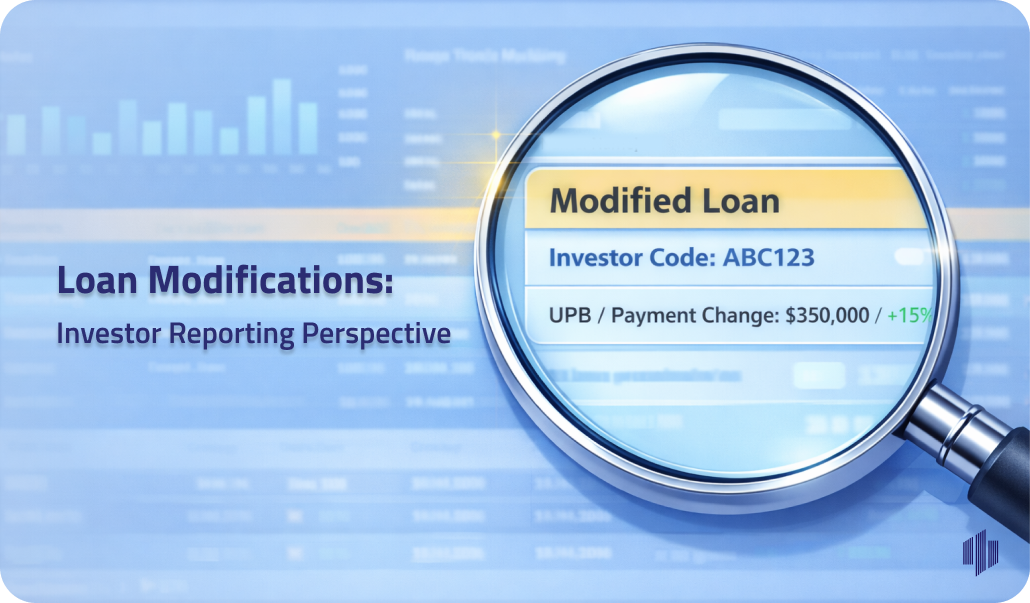
Loan Modifications – The Investor Reporting Perspective 

Understanding the Journey from Borrower to Servicer to Investor 

Loan modifications are not just about adjusting payment terms for a struggling borrower. Behind the scenes, they trigger a cascade of implications for servicers, investors, and the accounting teams responsible for transparent reporting. From the outside, it may look like a simple change, but for teams like investor reporting, investor accounting, and compliance, it’s a detailed, multi-step process that requires accuracy in loan data, cash flow tracking, and investor remittances. 

In this post, we’ll break down the loan modification journey from borrower to investor and focus on how these changes are captured, accounted for, and reported in investor portfolios. 

1. The Borrower’s Request: Where the Journey Starts 

When a borrower experiences financial hardship (job loss, medical expenses, market downturns), they often seek a loan modification as an alternative to delinquency or foreclosure. 

Common modification strategies include: 

  • Extending the loan term to reduce monthly payments 
  • Reducing the interest rate for affordability 
  • Changing amortization schedules 

For the borrower, the immediate impact is affordability. But for servicers and investors, there is lot more work after modification is approved. 

2. The Servicer’s Role: Implementing and Tracking Modifications 

The servicer acts as the bridge between borrower and investor. Once a modification is approved, servicers must: 

  • Update loan systems to reflect new terms (balance, maturity date, payment schedule). 
  • Re-amortize cash flows to ensure new principal/interest splits are calculated correctly. 
  • Classify the loan status (e.g., modified, performing, or still troubled debt). 
  • Report modifications according to investor and regulatory requirements. 

Servicers are also accountable for reconciling modified payments against investor reporting templates such as: 

  • Investor remittance reports (showing actual collections vs. expected cash flows). 
  • Loan-level disclosures (especially in securitized pools, where transparency is critical). 

3. How It Works in Investor Reporting Terms 

Here’s how data and cash flows move once a modification is finalized: 

Step 1 – Servicing System Update 

  • Loan master record updated with new terms. 
  • Amortization and escrow recalculated. 

Step 2 – Investor Reporting Extract 

  • Loan appears in the monthly/periodic investor reporting file with new P&I amounts and statuses. 
  • Event codes for modification included (e.g., GSE Loan Activity Reports). 

Step 3 – Remittance Adjustments 

  • For Scheduled/Scheduled servicing → remittance based on new scheduled P&I. 
  • For Actual/Actual servicing → remittance reflects actual borrower collections, now based on new terms. 

Step 4 – Accounting Impact 

  • Old accrual schedules reversed. 
  • New accruals posted based on modified rate. 
  • Modification fees tracked separately. 

Step 5 – Compliance & Audit 

  • Investor reporting teams ensure files meet investor-specific guidelines. 
  • Any mismatches between servicer data and investor acceptance are reconciled. 

For Investor Reporting, accuracy in these updates is critical. The wrong rate, date, or balance can cause reporting rejections or financial discrepancies. 

How Reporting Actually Works 

Investor reporting teams finally receive the modification file, which contains data related to fields such as: 

Original Term Modified Term 
Due Date Modified Due Date 
Interest Rate Modified Interest Rate 
Maturity Date Modified Maturity Date 
P&I Payment Modified P&I Payment 
Principal Balance Modified Principal Balance 
Principal Reduction Amount Capitalized Amount Total 

Additional data includes modification codes, descriptions, notes, and effective dates. 

Based on this file, reporting is done as follows: 

  • File Submissions → Servicers submit loan-level data files to investors, including terms, balances, delinquency status, and modification events. 
  • Event Coding → Special codes (modification effective date, trial payment, capitalized arrears) must be mapped correctly in the reporting file; otherwise, submissions are rejected. 
  • Cash & Data Alignment → Investor accounting teams reconcile accounts while reporting teams transmit loan data and remit funds to investors. Both must align perfectly to avoid exceptions. 

Challenges & Difficulties 

  1. Cross-Functional Teams → Coordination is required across customer care, loss mitigation, underwriting, investor reporting, accounting, legal, compliance, and servicing operations. 
  1. Data Rejections → If new loan terms don’t align with investor rules (e.g., GNMA pooling restrictions), reports can reject. 
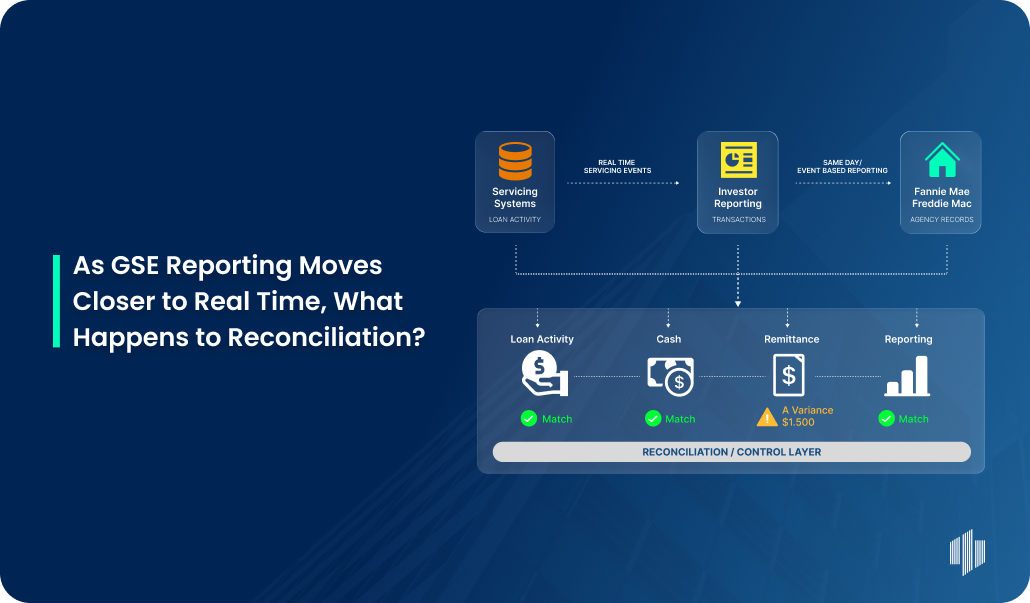
  1. Effective Reconciliation → Remitted cash vs. reported loan data must tie out to the penny — even minor mismatches trigger exception management. 

4. The Investor’s View 

For investors (Fannie Mae, Freddie Mac, GNMA, or private), modifications preserve asset value and help avoid foreclosure losses — but only if reporting is precise and timely. 

They focus on: 

  • Updated Loan Terms → Rate, term, P&I, UPB, deferred amounts 
  • Effective Dates → Modification date drives accrual changes and remittance calculations 
  • Delinquency Reset → In some cases, the loan is considered current post-modification 
  • Pool & Compliance Checks → For GNMA, a loan may need to be repooled or bought out before modification 

Closing Thoughts 

The journey of a loan modification doesn’t stop at making a borrower’s payment affordable. For investors, it’s about reliable reporting, accurate accounting, and transparent disclosures. 

Servicers play the crucial role of translating borrower-level relief into portfolio-level data that informs investment decisions. 

Loan modifications prove that mortgage servicing is more than just collecting payments — it’s about managing relationships between borrowers, servicers, and investors. For Investor Reporting professionals, it’s a reminder that every data field tells part of the loan’s journey, and accuracy at each stage ensures smooth operations for everyone involved.