Understanding the Journey from Borrower to Servicer to Investor
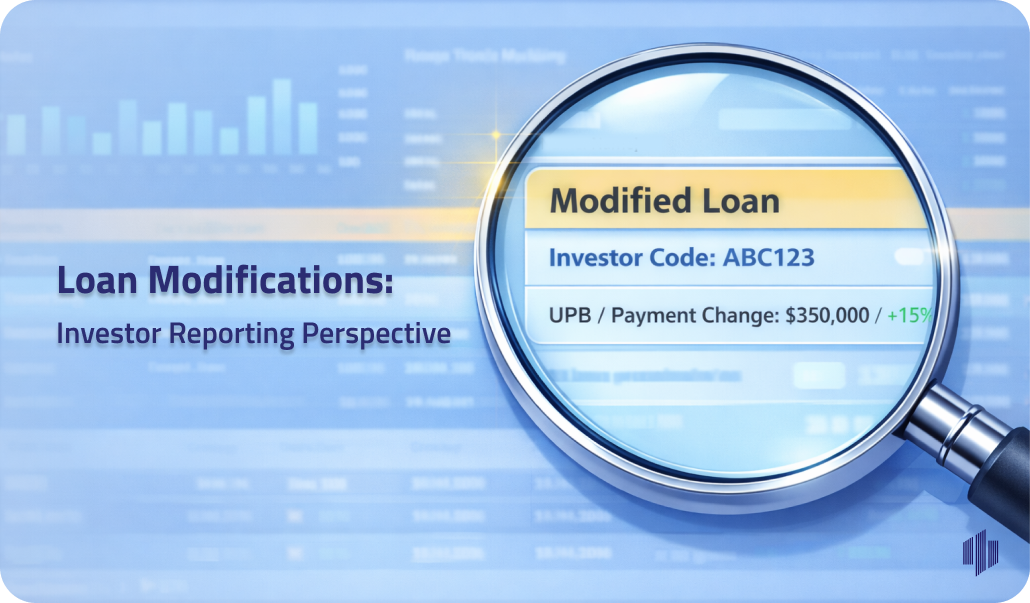
Loan modifications are not just about adjusting payment terms for a struggling borrower. Behind the scenes, they trigger a cascade of implications for servicers, investors, and the accounting teams responsible for transparent reporting. From the outside, it may look like a simple change, but for teams like investor reporting, investor accounting, and compliance, it’s a detailed, multi-step process that requires accuracy in loan data, cash flow tracking, and investor remittances.
In this post, we’ll break down the loan modification journey from borrower to investor and focus on how these changes are captured, accounted for, and reported in investor portfolios.
1. The Borrower’s Request: Where the Journey Starts
When a borrower experiences financial hardship (job loss, medical expenses, market downturns), they often seek a loan modification as an alternative to delinquency or foreclosure.
Common modification strategies include:
- Extending the loan term to reduce monthly payments
- Reducing the interest rate for affordability
- Changing amortization schedules
For the borrower, the immediate impact is affordability. But for servicers and investors, there is lot more work after modification is approved.
2. The Servicer’s Role: Implementing and Tracking Modifications
The servicer acts as the bridge between borrower and investor. Once a modification is approved, servicers must:
- Update loan systems to reflect new terms (balance, maturity date, payment schedule).
- Re-amortize cash flows to ensure new principal/interest splits are calculated correctly.
- Classify the loan status (e.g., modified, performing, or still troubled debt).
- Report modifications according to investor and regulatory requirements.
Servicers are also accountable for reconciling modified payments against investor reporting templates such as:
- Investor remittance reports (showing actual collections vs. expected cash flows).
- Loan-level disclosures (especially in securitized pools, where transparency is critical).
3. How It Works in Investor Reporting Terms
Here’s how data and cash flows move once a modification is finalized:
Step 1 – Servicing System Update
- Loan master record updated with new terms.
- Amortization and escrow recalculated.
Step 2 – Investor Reporting Extract
- Loan appears in the monthly/periodic investor reporting file with new P&I amounts and statuses.
- Event codes for modification included (e.g., GSE Loan Activity Reports).
Step 3 – Remittance Adjustments
- For Scheduled/Scheduled servicing → remittance based on new scheduled P&I.
- For Actual/Actual servicing → remittance reflects actual borrower collections, now based on new terms.
Step 4 – Accounting Impact
- Old accrual schedules reversed.
- New accruals posted based on modified rate.
- Modification fees tracked separately.
Step 5 – Compliance & Audit
- Investor reporting teams ensure files meet investor-specific guidelines.
- Any mismatches between servicer data and investor acceptance are reconciled.
For Investor Reporting, accuracy in these updates is critical. The wrong rate, date, or balance can cause reporting rejections or financial discrepancies.
How Reporting Actually Works
Investor reporting teams finally receive the modification file, which contains data related to fields such as:
| Original Term | Modified Term |
| Due Date | Modified Due Date |
| Interest Rate | Modified Interest Rate |
| Maturity Date | Modified Maturity Date |
| P&I Payment | Modified P&I Payment |
| Principal Balance | Modified Principal Balance |
| Principal Reduction Amount | Capitalized Amount Total |
Additional data includes modification codes, descriptions, notes, and effective dates.
Based on this file, reporting is done as follows:
- File Submissions → Servicers submit loan-level data files to investors, including terms, balances, delinquency status, and modification events.
- Event Coding → Special codes (modification effective date, trial payment, capitalized arrears) must be mapped correctly in the reporting file; otherwise, submissions are rejected.
- Cash & Data Alignment → Investor accounting teams reconcile accounts while reporting teams transmit loan data and remit funds to investors. Both must align perfectly to avoid exceptions.
Challenges & Difficulties
- Cross-Functional Teams → Coordination is required across customer care, loss mitigation, underwriting, investor reporting, accounting, legal, compliance, and servicing operations.
- Data Rejections → If new loan terms don’t align with investor rules (e.g., GNMA pooling restrictions), reports can reject.
- Effective Reconciliation → Remitted cash vs. reported loan data must tie out to the penny — even minor mismatches trigger exception management.
4. The Investor’s View
For investors (Fannie Mae, Freddie Mac, GNMA, or private), modifications preserve asset value and help avoid foreclosure losses — but only if reporting is precise and timely.
They focus on:
- Updated Loan Terms → Rate, term, P&I, UPB, deferred amounts
- Effective Dates → Modification date drives accrual changes and remittance calculations
- Delinquency Reset → In some cases, the loan is considered current post-modification
- Pool & Compliance Checks → For GNMA, a loan may need to be repooled or bought out before modification
Closing Thoughts
The journey of a loan modification doesn’t stop at making a borrower’s payment affordable. For investors, it’s about reliable reporting, accurate accounting, and transparent disclosures.
Servicers play the crucial role of translating borrower-level relief into portfolio-level data that informs investment decisions.
Loan modifications prove that mortgage servicing is more than just collecting payments — it’s about managing relationships between borrowers, servicers, and investors. For Investor Reporting professionals, it’s a reminder that every data field tells part of the loan’s journey, and accuracy at each stage ensures smooth operations for everyone involved.





![[List] 5 more best practices for custodial reconciliation](https://integradelivers.com/wp-content/uploads/2024/02/5-best-practices-in-custodial-reconciliation-part-2.png)
![[List] 5 best practices in custodial reconciliation](https://integradelivers.com/wp-content/uploads/2024/02/5-best-practices-in-custodial-reconciliation.png)


![[HousingWire] Embracing the future of mortgage servicing](https://integradelivers.com/wp-content/uploads/2026/02/embracing-the-future-of-mortgage-servicing.png)