
We’ve all heard (and possibly experienced) the tropes about failed tech projects. The main culprits are often easy to identify but tough to avoid.
In a recent BCG survey, business leaders identified three primary reasons for delays and failure:
- Lack of clarity or alignment on business outcomes
- Lack of realistic timelines
- Lack of resources fully dedicated to the program
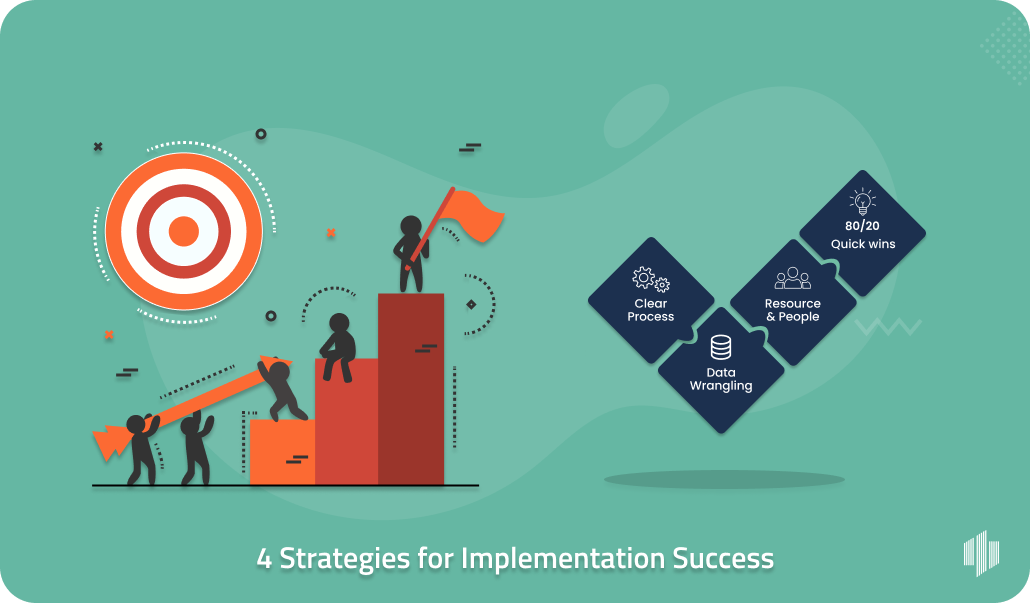
With the right approach, your implementation team can avoid these pitfalls. Check out these four winning strategies to kick off on the right foot–and win the race to successful implementation.
#1. Rethink the target process.
The biggest mistakes come from the wrong mindset. If your team is simply looking to do the same thing but faster, it may result in short-term success but also a missed opportunity in the long term. This is the time to transform the business process to capitalize on new capabilities.

Take our friend in the image above, from 1870. The author conceived of a flying machine, using birds as the functional model. This invention doesn’t improve flight. Instead, it’s a good example of the same-thing-but-faster mindset, limited by what was available back then.
Below are some tips to rethink the target process in the context of achieving true transformation:
- Map the current process as it really is. This might seem like a tedious step, but it often illuminates redundancies and workarounds that can be eliminated in the new process. Listen to the people who complete the relevant business processes each day–executive sponsors’ process maps usually document how a process “should” go, but don’t include all the workarounds, dead ends, or shortcuts in the real-life business process. Try to uncover these early!
- Align the “to-be” process with desired results. We often find that clients are initially rigid in their concept of what they need, and that they may not be open to another solution—even a ready-made one. Instead of focusing on what you think the new process should look like, focus on the results you’re looking for (e.g., greater efficiency, better visibility, or better accuracy). Your technology partner can then help you map a “to-be” process that fulfills those goals. This all starts with having a clear picture of the outcome.
- Prioritize customizations and enhancements. No technology solution will 100% fit your organization’s unique business process right out of the box. But every new option you request doesn’t need to be available from Day 1. Decide which new features are truly required to complete your business process, and which are “nice to have” enhancements. Your technology partner can create a roadmap that includes all these changes, so you have an approximate timeline for deployment. It is best to discuss these early to avoid any retrofitting in the future.
#2. Wrangle your data.

We’ll stick with the 1870’s and consider this cowboy wrangling an ostrich. This isn’t so different from mortgage servicers trying to get a firm grasp on their data!
Every mortgage servicing operation is awash with data: from MSP reports, bank statements, and wire reports, to Snowflake, BDE, and even spreadsheets, the list of potential data sources can seem endless. It’s no wonder, then, that data—or really, lack thereof—often presents a considerable roadblock to successful implementation.
- Understand what data you need—and where it all comes from. During one implementation, we discovered that several important data points weren’t included in the data warehouse as expected, so we had to supplement with raw MSP reports. Audit your data to ensure that it all “comes from” the expected source; that it’s complete; and that it’s available when you need it (e.g., daily or monthly). Getting the full picture early saves time.
- Consider data requirements for downstream processes. For example, we often see that Investor Reporting handles all the wires—and then Investor Accounting needs the related loan-level information. Understanding these requirements can help ensure that you don’t “break” any of your data flows during implementation. It can also help you identify opportunities to improve data flow. For instance, the ability to produce accounting entries as part of our subservicing billing solution came from a request in mortgage accounting, a separate group from our immediate project partners in the operation.
- Identify all data “owners.” You’ll need a full picture of your organization’s data ecosystem. Usually, different individuals or teams oversee data security and/or transmission, while others understand the operational context of the servicing data you’re using. You’ll need expertise and input from all of them, even if they won’t be intimately involved in every step of the implementation. This information is critical for assigning notifications and other workflows to fix any data discrepancies as these are discovered during automation.
- Consider any “to be” changes. Will you be using the same data sources for the long term? If there’s a change coming soon (such as changing servicing systems), it may be better to navigate that transition before implementing a new, dependent software system. The answer may not be very clear at this stage. However, it is important to envision a process to manage any changes to data sources along with a governance plan.
#3. Dedicate the right resources.
Every member has their own super powers (and version of kryptonite!) Ultimately your people will make or break your implementation efforts. And it’s not just about getting the “right” people, it’s also about ensuring these people have the capacity—and mindset—for the implementation.
- Keep your team tight! A team with too few people won’t have adequate time or organizational reach. An overly inclusive team often gets bogged down in minutia. The most effective teams include only engaged, active decision makers and direct stakeholders who understand the strategic and tactical implications of the relevant business processes (and, of course, a stellar project manager!). The greater team will remain informed, but the core team should remain small and nimble.
- Consider the team’s workload. An implementation most acutely affects your super users, who will often be responsible for running parallel processes—they’ll essentially be doing everything twice, for a while. Ensure that these resources aren’t also assigned to other projects or initiatives. In our experience, the most successful (and fastest) implementations are those where at least a few super users are solely dedicated to the implementation and the “to-be” business process. Fractional schedules where executives dedicate certain hours each month work well. However, not making effective use of this time (or overextending the commitment) will ultimately lead to lost productivity.
- Identify your early adopters. Let’s be real: some employees are going to more resistant to change than others. Avoid putting them on your implementation team and bring them back when the process is more settled. Instead, look for people who have demonstrated fluency in your existing technology, along with eagerness to learn new things and expand their skill set. Ideally, this person will also be a trusted leader (even informally) who can nudge others toward adoption. The excitement will quickly flourish from within.
#4. Focus on quick wins.
As you plan your implementation, look for opportunities for quick wins. These help bolster your implementation team’s confidence and provide immediate proof of concept to end users. It also gets people into a rhythm of using a new system or running a new process. This will make introducing bigger changes related to the implementation much easier.
- Use the good old Pareto principle. The 80/20 rule consistently plays a starring role in our successful billing implementations. Clients often find, for example, that the majority of their bills fit into the same format (e.g., similar billing lines or remittance packages), so we tackle those first. These details are typically discussed during Discovery or before.
- Start with the easy stuff first. When it comes to implementing the recon system, we almost always start with T&I cashbook and custodial reconciliations. Starting with the least complex elements will give your team the experience and confidence to take on the more complicated scenarios associated with P&I A/A. P&I S/S are usually last since they’re the most complicated and generally comprise the smallest number of recons. Again, circumstances and priorities will always play a role in how best to plan the implementation.
- Go for the biggest time savers. We often find that our clients spend hundreds of hours each month on a single manual process that we can easily automate. In this case, we often tackle that process first, to demonstrate meaningful time savings right away—especially important when your implementation team is still running parallel processes.
Bonus: Remember, you’re racing toward adoption.
Your work doesn’t end when your new software is up and running. Remember that an implementation is ultimately about adoption—people using that software. The most successful implementations are those where the team focuses on adoption from the very beginning.
- Plan engagement with your broader team. Decide when you’ll start transitioning the entire team to using the new software. The implementation need not be complete for this to happen. For example, once we’ve set up the T&I cashbook, end users can get comfortable working those reconciliations in the system while the implementation team moves on to more complicated scenarios.
- Communicate early and often. Suprises are great for parties. Not so much at work. The more often you communicate with end users and other stakeholders, the more likely you are to get their cooperation. From the very beginning, explain the relevance of the new technology and how it will improve operations or make people’s jobs easier. It can also be useful to show proof of concept, such as demonstrating a simple reconciliation in the new system.
- Create training materials and SOPs as you go. We often find that Super Users will use our standard training materials as a starting point, then tailor them for their organization’s idiosyncrasies. These will give you a jumpstart later, when it’s time to create more formal training materials.
What are some implementation challenges you faced recently in your organization? What would you say was the biggest contributor in getting it back on track (or changing directions)?