
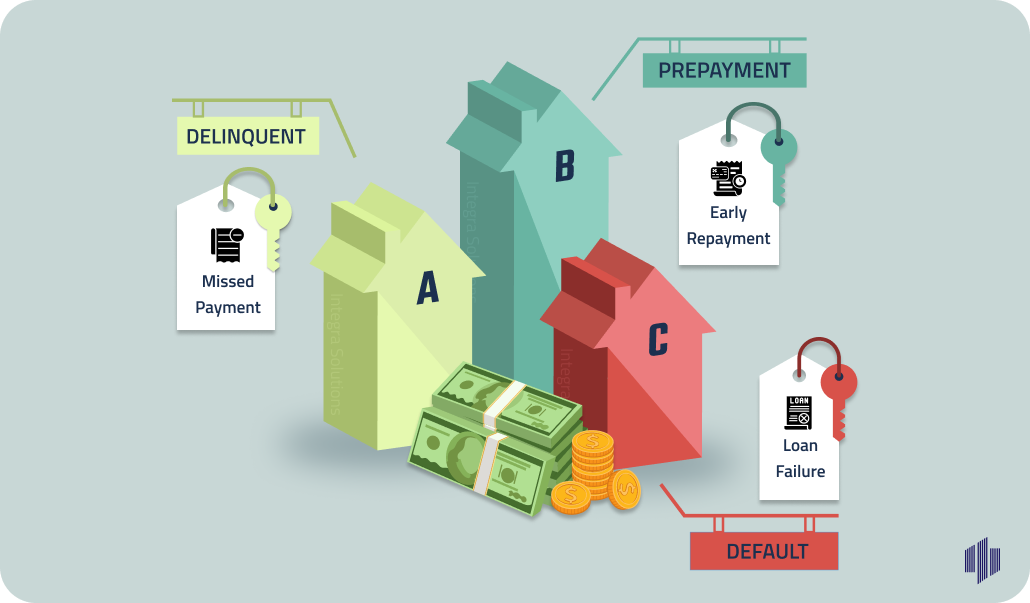
If you’re investing in mortgage-backed securities (MBS) or analyzing loan performance, you’ve likely encountered the terms prepayment, delinquency, and default. They’re more than industry jargon—they directly impact your returns.
Let’s break down what they mean and how they affect your investments.
First, What Are Mortgage-Backed Securities (MBS)
A mortgage-backed security is a type of investment where you earn income from mortgage payments made by homeowners. Imagine you invest in a pool of home loans. Every time a homeowner pays their mortgage, you receive a part of that payment. Sounds great, right?
But what happens if borrowers pay early, miss payments, or stop paying altogether?
That’s where prepayment, delinquency, and default come in.
1. What is Prepayment?
Prepayment happens when a borrower pays off their loan early, that is before the full-term ends.
Why Do Borrowers Prepay?
- They refinance their mortgage for a lower interest rate
- They sell their home
- They make extra payments to reduce debt faster
How Does Prepayment Impact Investors?
- Lost future interest payments (which are the main source of income for investors)
- Reinvestment risk: The investor may have to reinvest at a lower interest rate
Example: Imagine Investor “A” places $100,000 into a pool of MBS expecting 6% annual returns:
- Year 1: 15% of borrowers prepay. Returns dip because those loans stop generating interest.
- In short: Prepayment reduces the total return on investment.
2. What is Delinquency?
Delinquency occurs when a borrower misses a scheduled mortgage payment.
Common Causes:
- Job loss or income reduction
- Unexpected expenses or emergencies
- Poor financial management
Delinquency is usually measured in days past due (30, 60, 90 days, etc.).
How Does Delinquency Impact Investors?
- Uncertainty in cash flow
- Increased loan servicing costs (collection efforts, legal actions)
- Risk signal: The longer the delinquency, the higher the chance of default
Example: Imagine Investor A places $100,000 into a pool of MBS expecting 6% annual returns:
- Year 2: 10% of loans become delinquent. Irregular payments begin to reduce monthly income.
Delinquency is like a warning light for investors, it tells them a borrower might default soon.
3. What is Default?
Default means the borrower has failed to meet their mortgage obligation for a long period (typically over 90 days) and is unlikely to repay the loan.
What Happens After Default?
- The loan becomes “non-performing”
- Lenders may start foreclosure
- Property may be sold to recover losses
How Does Default Impact Investors?
- Significant loss of expected income
- Reduced principal recovery (sale of foreclosed property may not cover full loan amount)
- Higher risk perception among investors
Example: Imagine Investor A places $100,000 into a pool of MBS expecting 6% annual returns:
- Year 3: 5% of loans default. The investor loses a portion of the principal as foreclosure drags on.
Default directly reduces investor returns and affects portfolio performance.
Even in a diversified MBS, the actual return ends up being lower than expected.
Simple Example
Imagine you invest in a pool of 100 mortgages:
| Scenario | Borrowers | Effect on You |
| Prepayment | 20 borrowers pay early | You get your money back faster, but lose future interest |
| Delinquency | 10 borrowers are 60 days late | Your income becomes uncertain |
| Default | 5 borrowers stop paying completely | You lose some of your investment |
Combined Impact on MBS Investors
All three events affect cash flow, risk, and investment returns.
| Factor | Impact on Cash Flow | Risk Level | Investor Concern |
| Prepayment | Decreases future income | Medium | Reinvestment risk |
| Delinquency | Delays income | High | May turn into default |
| Default | Cuts income and capital | Very High | Loss of investment |
How Do Investors Manage These Risks?
Investors use several strategies:
- Credit scoring & risk models to select better loans
- Diversification (invest in many loans, not just one type)
- Insurance or guarantees (like Fannie Mae/Freddie Mac-backed loans)
- Monitoring KPIs: Like Prepayment Rate, Delinquency Rate, and Default Rate
Real-World Applications
If you work in mortgage analytics, loan servicing, or as a business analyst, understanding these terms helps you:
- Analyze portfolio performance
- Build dashboards (e.g., in Power BI)
- Design risk prediction models (e.g., in Python)
- Communicate better with stakeholders and investors
Summary Table
| Term | Meaning | Investor Impact |
| Prepayment | Early repayment of loan | Lower returns, faster capital recovery |
| Delinquency | Missed payments (30+ days) | Irregular cash flow, warning sign |
| Default | Failure to repay (often >90 days) | Loss of principal and income |
Final Takeaway: Prepayment, delinquency, and default are the core risks in mortgage investing. Understanding how they impact your cash flow and portfolio performance gives you the edge—whether you’re managing MBS, analyzing loans, or building predictive models.